


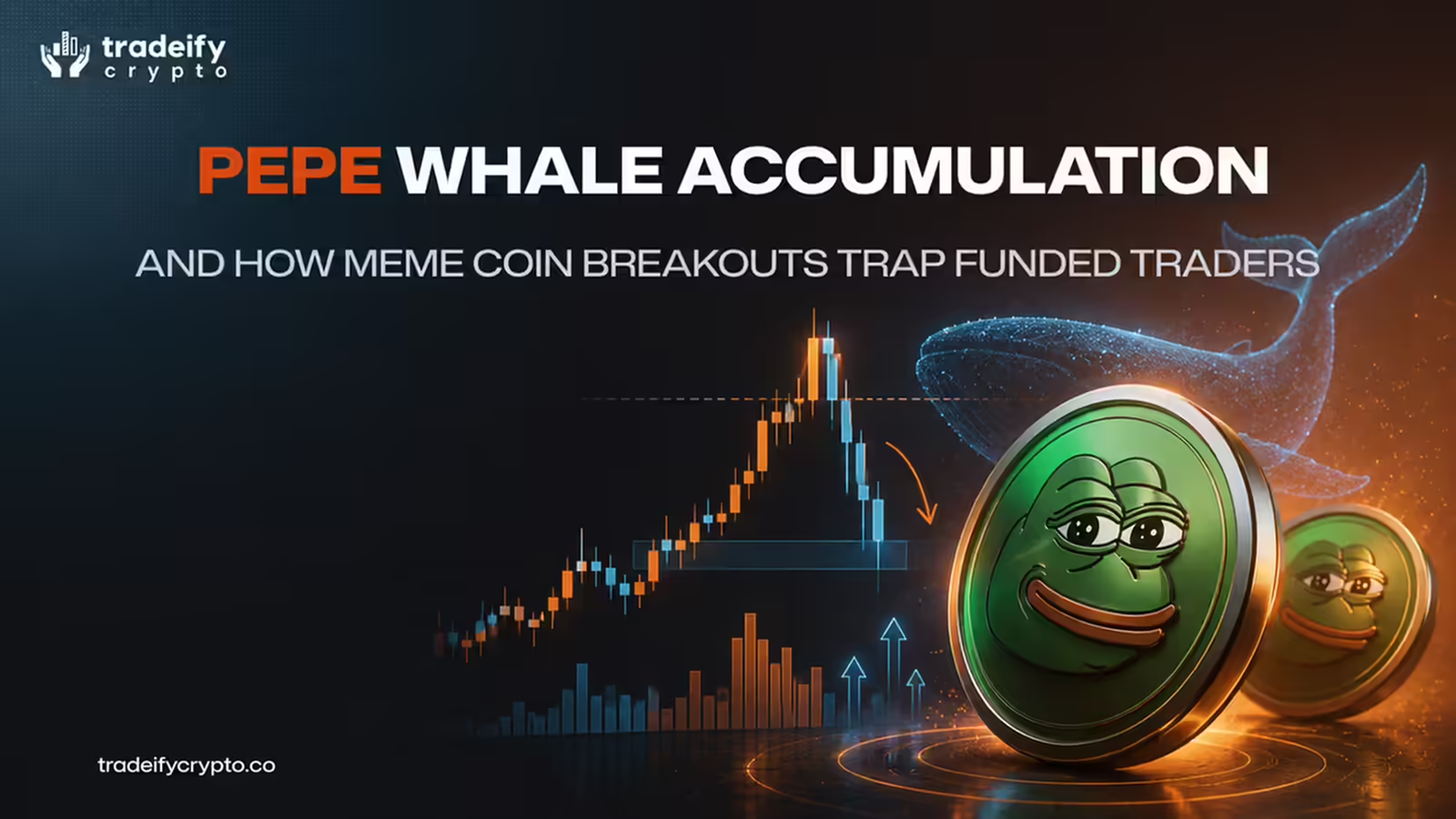
PEPE Whale Accumulation and How Meme Coin Breakouts Trap Funded Traders


.svg)

TL;DR: Tradeify Crypto supports PEPE/USD on DXTrade as an altcoin pair with 2:1 leverage, a 3% daily drawdown checked in real time, plus a 6% EOD trailing max drawdown for Instant Funding accounts or a 6% static maximum drawdown for 1-Step and 2-Step Evaluation accounts, a 0.04% commission per trade, a 20-second minimum hold, and no hedging. PEPE trades more on attention, whale accumulation, meme coin sentiment, exchange access, liquidity sweeps, open interest, funding, and Ethereum meme rotation than on cash flow or protocol revenue, so funded crypto traders should avoid late breakout entries, wait for sweep confirmation, define invalidation beyond the sweep, size below daily drawdown pressure, and compare PEPE with DOGE, SHIB, BONK, WIF, FLOKI, PENGU, and POPCAT before treating a breakout candle as real demand.
- PEPE breakouts can be real momentum events or liquidity traps for late traders.
- Whale accumulation is useful context, but not an entry signal by itself.
- Funded traders should wait for sweep confirmation and define invalidation beyond the sweep.
- Tradeify Crypto risk controls make position sizing more important than catching every meme coin move.
PEPE is one of the clearest examples of how meme coin trading has changed. What started as a retail-driven internet token has become a high-liquidity momentum asset watched by whales, derivatives traders, social media communities, and short-term speculators.
That shift matters because meme coin breakouts are not as simple as they look on a chart. When PEPE pushes above a widely watched resistance level, the move may be real. It may also be a liquidity trap designed to trigger breakout buyers, short stops, and forced positioning before price reverses.
For funded crypto traders, this creates a specific problem. Meme coins can move fast enough to create opportunity, but they can also move fast enough to damage an account before the trader has time to adjust. On Tradeify Crypto, PEPE/USD is available as a supported altcoin pair, and altcoins trade with 2:1 leverage. That gives traders access to PEPE volatility, but it also means every trade has to be planned around real-time daily drawdown, account-type max drawdown, execution cost, and account rules.
Why PEPE Trades Differently From Large-Cap Crypto
PEPE does not trade like Bitcoin or Ethereum. It has no cash flow, no staking yield, no smart contract platform revenue, and no deep fundamental valuation model. PEPE trades primarily on attention, liquidity, exchange access, whale positioning, and meme coin sentiment.
That does not make it irrelevant. It means traders need the right framework.
PEPE’s appeal comes from its ability to move quickly when risk appetite returns to meme coins. It can attract retail traders looking for high percentage upside, whales looking for momentum liquidity, and derivatives traders looking for volatility. The same features that make PEPE attractive also make it dangerous.
A large-cap asset like BTC can absorb more flow without extreme dislocation. PEPE can move sharply when liquidity clusters break. That creates the kind of chart action that draws in breakout traders and punishes late entries.
How PEPE Whale Accumulation Works
Whale accumulation is one of the most important concepts in meme coin trading. A whale is a large holder or large trader with enough capital to influence short-term liquidity. In PEPE, whale activity can matter because large wallets may accumulate during quiet periods and distribute into high-volume rallies.
The basic pattern often looks like this:
- PEPE sells off or consolidates
- Large wallets accumulate near support
- Retail attention remains low
- Price begins moving toward resistance
- Breakout traders enter late
- Whales distribute into the new liquidity
This does not mean every PEPE rally is manipulated. It means traders should understand that large players need liquidity. They cannot easily enter or exit massive positions when the market is quiet. They need active buyers and sellers on the other side.
Breakouts provide that liquidity.
When PEPE breaks above a level that everyone is watching, buy stops can trigger, shorts may cover, and momentum traders may chase. That sudden wave of demand gives large holders an opportunity to sell into strength without immediately collapsing the market.
Why PEPE Breakouts Trap Meme Coin Traders
A breakout trap happens when price moves above a key resistance level, attracts buyers, and then quickly reverses back below that level. In meme coins, this pattern is common because attention and liquidity can appear suddenly and disappear just as quickly.
A PEPE breakout trap usually has four phases.
| Phase | What Happens |
|---|---|
| Setup | Price compresses below a visible resistance level |
| Trigger | Price breaks above resistance and activates buy stops |
| FOMO | Retail traders chase the breakout candle |
| Reversal | Large sellers distribute into demand and price falls back into range |
The trap works because the level is obvious. Short sellers place stops above resistance. Breakout traders place entries above resistance. Once price pushes through the level, both groups become buyers at the same time.
That sudden buying can make the move look convincing. But if the buying is mostly forced execution and emotional chasing, the breakout may not have durable demand behind it. Once the forced buying is exhausted, price can reverse quickly.
PEPE Buy-Side Liquidity Sweeps
A buy-side liquidity sweep happens when price moves above recent highs to trigger liquidity resting above the market. This can include short stops, breakout entries, and take-profit orders.
In PEPE, a buy-side sweep can happen quickly because meme coin traders often cluster around the same obvious levels. If price pushes above a prior high, the market may briefly accelerate as orders trigger.
The important question is what happens next.
A healthy breakout should hold above the breakout level or reclaim it after a shallow retest. A trap usually fails quickly and closes back below the level. The candle may leave a long upper wick, showing that buyers were absorbed and sellers regained control.
For funded traders, the danger is entering during the sweep instead of after confirmation. Buying the first breakout candle can place the trader directly into the area where whales are selling.
PEPE Sell-Side Liquidity Sweeps
The same process can happen in reverse. A sell-side liquidity sweep occurs when price drops below support, triggers stop losses from long traders, and then reverses higher.
This can be an accumulation tactic. If whales want to buy PEPE without pushing price up, they may benefit from a selloff that forces weaker holders to exit. Once sell stops are triggered, large buyers can absorb supply at lower prices.
A sell-side sweep may create a better long setup than a clean breakout. Instead of chasing strength, the trader waits for price to flush below support, reclaim the level, and show that sellers are trapped.
That kind of setup is still risky, but it gives the trader a clearer invalidation point. If price fails to reclaim support, the trade is invalid. If price reclaims and holds, the sweep may have created a stronger base.

Trade Crypto Without Limits
Tradeify is built for crypto traders who want clarity, consistency, and speed — not surprises.


Why PEPE Volatility Is Dangerous in Funded Accounts
Meme coin volatility is not only a chart problem. It is an account management problem.
On Tradeify Crypto, PEPE/USD is a supported altcoin pair. Like other altcoins, it trades with 2:1 leverage. Tradeify Crypto accounts use a 3% daily drawdown checked in real time, plus an account-type max drawdown rule: Instant Funding accounts use a 6% EOD trailing max drawdown, while 1-Step and 2-Step Evaluation accounts use a 6% static maximum drawdown.
That distinction matters in two directions. The daily drawdown is enforced in real time. If the account hits the 3% daily threshold during the session, it fails immediately, even if it might have recovered later. For Instant Funding accounts, the 6% EOD trailing max drawdown only locks in improvements at session close, while Evaluation accounts use a static max drawdown floor instead.
PEPE can wick aggressively during liquidity sweeps. A position may move from green to red quickly, especially if the trader enters late into a breakout. In a funded account, that can be enough to push the account into the daily drawdown threshold before the trader has time to react.
Tradeify Crypto also charges a 0.04% commission per trade and uses a 20-second minimum hold rule. That means traders should not approach PEPE as an ultra-fast scalp. The better framework is a planned setup with defined risk, clear invalidation, and enough room for normal volatility.
How PEPE Breakouts Create Drawdown Risk
The most common trap for funded traders is buying a PEPE breakout too late.
A typical sequence looks like this:
- PEPE breaks above resistance
- The trader enters after the large green candle
- Price extends briefly
- Whales or early buyers sell into the move
- Price falls back below the breakout level
- The trader hesitates because the move still looks possible
- The unrealized loss grows quickly
- The account approaches the daily drawdown threshold
The problem is not always the trade idea. PEPE may still be in a broader bullish structure. The problem is the entry and risk placement. A late entry gives the trader a poor reward-to-risk profile and leaves the position vulnerable to the exact reversal that often follows a liquidity sweep.
For funded traders, a breakout is only useful if the invalidation is close enough to size the trade responsibly.
PEPE Winners and Consistency Risk
Meme coin trades can create unusually large winning days. That sounds like a good thing, but funded traders still need to understand the account structure they are trading.
A PEPE breakout can move quickly enough to generate a large share of total profit in one session. On Instant Funding accounts, one large meme coin win could push the account outside the 20% Consistency Score threshold needed for payouts. Traders should review the specific rules attached to their account in the Tradeify Crypto help center before planning high-volatility meme coin trades.
For most traders, the answer is simple: do not build the entire account plan around one meme coin breakout. Sustainable funded trading depends on repeatable execution, not one perfect candle.
PEPE Execution Risk During Fast Moves
Meme coin trading also has an execution problem. During a fast breakout or breakdown, spreads can widen, liquidity can disappear, and market orders can fill worse than expected.
Even if PEPE is liquid compared with smaller meme coins, it can still move quickly during volatile conditions. Traders should avoid assuming that the chart price is the exact execution price they will receive.
This is why trade planning should include:
- Expected entry
- Invalidation level
- Estimated commission cost
- Possible spread expansion
- Position size
- Maximum acceptable loss
- Whether the setup still works if the fill is worse than expected
On Tradeify Crypto, the 0.04% commission per trade is known and calculated on the notional value of the position, which helps with cost planning. But slippage and spread still depend on market conditions. During a meme coin breakout, costs are not just commissions. They also include the risk of getting filled into an unstable candle.
PEPE Compared With DOGE, SHIB, BONK, and WIF
PEPE is part of a broader meme coin market, and traders should not analyze it in isolation. Meme coin capital often rotates between names rather than staying in one asset.
DOGE is usually the most established meme coin liquidity benchmark. It has deeper history, larger recognition, and broader exchange access. SHIB often trades as a more ecosystem-oriented meme asset, with burn narratives and Shibarium-related activity affecting sentiment. BONK and WIF are closely tied to Solana meme coin rotation and can move when Solana ecosystem activity increases.
PEPE sits between those categories. It has stronger recognition than many smaller meme coins, but it still trades like a high-beta attention asset. It can benefit when meme coin sentiment improves, but it can also reverse quickly when attention rotates elsewhere.
A simple framework:
| Token | Main Driver |
|---|---|
| DOGE | Broad meme coin sentiment and social attention |
| SHIB | Burn narratives, ecosystem activity, meme coin rotation |
| PEPE | Whale accumulation, breakout liquidity, Ethereum meme sentiment |
| BONK | Solana ecosystem rotation |
| WIF | Solana meme momentum and social trend strength |
For Tradeify Crypto traders, these distinctions matter because several meme coins are available to trade, including PEPE, DOGE, SHIB, BONK, WIF, FLOKI, PENGU, POPCAT, and others. The same risk rules apply, but each coin has a different volatility profile.
How to Trade PEPE Without Chasing Traps
The main adjustment is to stop treating every breakout as an entry signal.
A better PEPE framework is:
- Identify the obvious liquidity level
- Wait for price to sweep that level
- Watch whether the breakout holds or fails
- Enter only after confirmation
- Place invalidation beyond the sweep
- Size the trade so the stop does not threaten the account
For a failed breakout short, confirmation might be a move above resistance followed by a close back below the level. For a sweep-and-reclaim long, confirmation might be a move below support followed by a reclaim and hold.
The key is patience. Meme coin traders often lose because they enter when the market is most emotional. Funded traders need to enter when the trade is most defined.
A PEPE Risk Framework for Funded Accounts
Before trading PEPE, a funded trader should answer these questions:
- What is the setup?
- Where is the liquidity sweep likely to occur?
- What confirms the sweep?
- Where is the trade invalid?
- What is the maximum loss if invalidation hits?
- Does that loss fit inside the account’s daily drawdown room?
- Is the trade being taken because of confirmation or FOMO?
The position size should come from the invalidation level, not from excitement about the move. If the stop needs to be wide because PEPE is volatile, the position should be smaller.
A practical approach is to risk less on PEPE than on more liquid majors. Even with 2:1 leverage, PEPE can move enough to create account stress if the trade is oversized.
Why the First PEPE Green Candle Is Risky
The first large green candle in a PEPE breakout is usually where the most emotion appears. Traders see the candle, social media starts reacting, and the fear of missing out becomes intense.
That candle may be the start of a real move. It may also be the liquidity event that lets larger holders sell.
Instead of buying the first green candle, traders can wait for one of three outcomes.
| Outcome | Interpretation |
|---|---|
| Breakout holds and retests support | Stronger long setup |
| Breakout fails back into range | Possible trap or short setup |
| Price extends without retest | Higher risk of late entry |
Missing a move is better than entering a trap. In a funded account, protecting the account is more important than catching every meme coin rally.
The conversation happens live
Blog comments are too slow for crypto. Join 12,000+ traders in our Discord to discuss this article, share charts, and debate the market in real-time.
Join Discord
What PEPE Whale Accumulation Does Not Guarantee
Whale accumulation can be useful, but it does not guarantee a breakout. Large wallets can be wrong. They can accumulate early. They can also accumulate for reasons that are not obvious from the outside.
A trader should not buy PEPE only because whales are buying. Whale accumulation is a context clue, not an entry signal.
Better confirmation includes:
- Price holding above support
- Failed breakdowns reclaiming quickly
- Rising volume on upward moves
- Reduced selling after liquidity sweeps
- Meme coin sector strength
- Bitcoin stability
- PEPE reclaiming key resistance after a retest
The stronger the confirmation, the less the trader has to rely on guessing whale intent.
What to Watch Before a PEPE Trade
A useful PEPE watchlist includes:
| Watchlist Item | Why It Matters |
|---|---|
| Bitcoin trend | Meme coins struggle during broad risk-off moves |
| Ethereum trend | PEPE is closely tied to Ethereum meme liquidity |
| Meme coin sector strength | Confirms whether attention is rotating into memes |
| PEPE whale wallet activity | Helps identify accumulation or distribution |
| Exchange inflows | May signal possible selling |
| Open interest | Shows whether leverage is building |
| Funding rates | Can reveal crowded long or short positioning |
| Key support and resistance | Defines sweep zones |
| Volume | Confirms or weakens breakout signals |
| Account drawdown room | Determines whether the trade is worth taking |
For Tradeify Crypto traders, the final filter should always be account risk. If the trade requires too much room for the stop, it is not a good funded-account trade, even if the PEPE setup looks attractive.
When Not to Trade PEPE
Avoid PEPE trades when:
- Price has already moved too far without a retest
- The setup depends on chasing a vertical candle
- Bitcoin is breaking down
- Meme coin sentiment is fading
- Open interest is crowded and price is stalling
- The invalidation level is too far away
- The trade would consume too much daily drawdown room
- You are entering because social media is euphoric
A trader does not need to catch every PEPE move. The best opportunities are the ones where the market structure, liquidity sweep, and risk profile all line up.
PEPE Breakout Trading Bottom Line
PEPE whale accumulation can create powerful breakout setups, but it can also create dangerous traps. Large players need liquidity, and visible resistance levels often provide it. When PEPE breaks above an obvious level, the move may trigger short stops and breakout buyers at the exact moment larger holders are ready to sell.
For funded traders, the risk is not just being wrong. The risk is being late, oversized, or caught in a liquidity sweep that damages the account. On Tradeify Crypto, PEPE/USD is available as a supported altcoin pair with 2:1 leverage, but traders still need to respect the 3% daily drawdown checked in real time, the applicable 6% max drawdown rule for the account type, the 0.04% commission per trade, the 20-second minimum hold rule, and no-hedging rules.
The best PEPE traders do not blindly chase breakouts. They identify where liquidity is likely to sit, wait for the sweep, confirm whether price holds or fails, and size the trade around account survival. In meme coin trading, the breakout is not always the opportunity. Sometimes it is the trap.

Keep Reading
See all
Dogecoin Trading Beyond the Meme Coin Label
PEPE Whale Accumulation and How Meme Coin Breakouts Trap Funded Traders




.png)
.webp)