


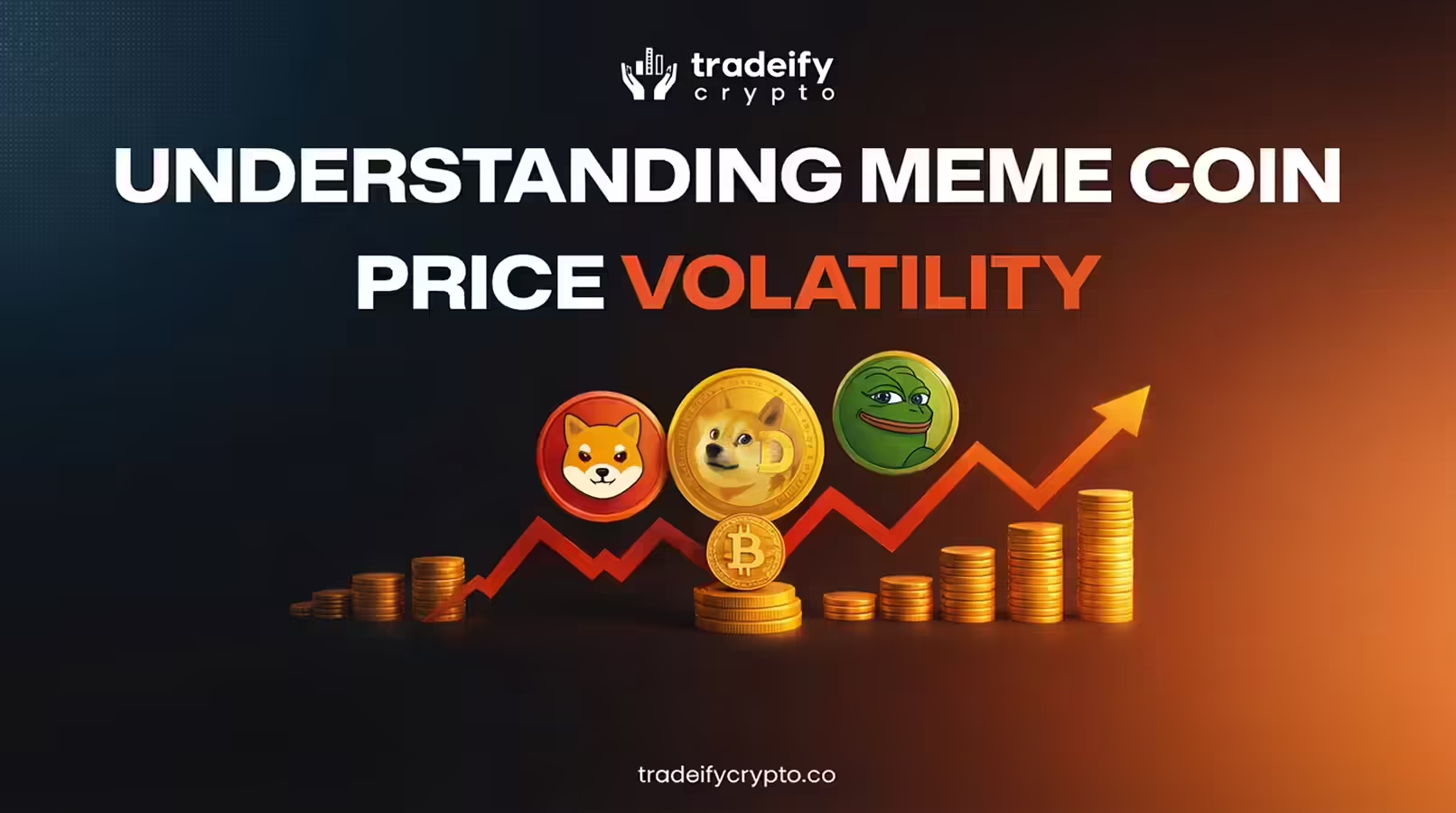
Understanding Meme Coin Price Volatility


.svg)

TL;DR: Meme coins are sentiment-driven assets where price volatility is structurally driven by Unit Bias (retail preference for low-priced tokens), Whale Dominance (ownership concentration creating flash crash risk), and Sentiment Amplification (social media feedback loops). The persistent "$1 myth" for coins like SHIB is mathematically impossible, requiring a $589 trillion market cap against $100-$123 trillion global GDP. Tools like the MarketVector Meme Coin Index and Fear and Greed Index help measure sector risk, but volume must always be contextualized by 2% liquidity depth. Regulators including the NY DFS and UK FCA warn of exceptional fraud risk, and research shows meme coins amplify rather than hedge Bitcoin volatility.
Executive Summary of Meme Coin Price Volatility
The digital asset ecosystem has evolved beyond foundational blockchain protocols to include a high-risk, high-velocity asset class known as "meme coins." Often dismissed as jokes, these assets now command billions in daily trading volume and present unique challenges for risk management. For traders utilizing platforms like Tradeify Crypto, understanding the mechanics behind these assets is not merely about tracking price: it requires a rigorous examination of behavioral economics, market structure fragility, and regulatory headwinds.
This report provides an exhaustive analysis of meme coin price volatility. It explores the structural drivers of price swings, including "Unit Bias," "Whale Dominance Scores," and "Sentiment Amplification." The text examines the mathematical impossibilities behind the "$1 Myth," quantifies the liquidity risks inherent in these ecosystems, and reviews the growing body of regulatory warnings from institutions like the New York State Department of Financial Services (NYDFS). By synthesizing academic research with real-time market data, this analysis aims to equip traders with the analytical framework necessary to trade sentiment-based virtual currencies.
Defining Fragility in Sentiment Based Meme Coin Assets
To understand volatility in the digital asset market, one must first define the meme coin asset class correctly. Regulators and academics have moved away from the term "cryptocurrency" for these assets, favoring more descriptive classifications that highlight their inherent instability.
Instability of Sentiment Based Meme Coin Currencies
The New York State Department of Financial Services (NYDFS) has used the term "sentiment-based virtual currencies" in consumer-risk communications related to meme-asset behavior. Unlike utility tokens (which grant access to a protocol) or security tokens (which represent equity), sentiment-based assets derive their value almost exclusively from social consensus and speculative fervor. NYDFS risk guidance warns that rapid token proliferation and weak oversight in parts of the market can increase instability relative to assets with clearer utility foundations.
The Memecoin Ecosystem Fragility Framework (ME2F)
Recent academic research has proposed structured ways to analyze meme-asset risk. One 2025 preprint introduced the Memecoin Ecosystem Fragility Framework (ME2F), which evaluates risk across three dimensions:
Volatility Dynamics Score (VDS): Measures persistent and extreme price swings, adjusting for "spillover" effects from base chains like Ethereum or Solana.
Whale Dominance Score (WDS): Quantifies ownership concentration. High concentration among "whales" (large holders) creates structural fragility, as a single exit can crash the market.
Sentiment Amplification Score (SAS): Measures how sensitive an asset's price is to attention-driven shocks (e.g., a tweet or a subreddit trend).
The ME2F framework reveals that fragility is not evenly distributed; politically themed tokens often concentrate the highest risks, while established meme coins like DOGE occupy an intermediate range.
The Mechanics of Meme Coin Volatility
The extreme price swings observed in meme coins (where assets can rise 1,000% and collapse 90% in the same week) are not random. They are the result of specific psychological and structural drivers inherent to the sector.
Unit Bias and the Psychology of Cheap Meme Coin Prices
A primary driver of retail capital into meme coins is Unit Bias. This is the psychological tendency for investors to prefer owning "millions" of a lower-priced token (e.g., Shiba Inu at $0.00001) rather than a fraction of a high-priced asset like Bitcoin.
The Illusion of Value: Investors often irrationally believe that a low unit price equates to "undervalued" potential.
Market Impact: In market conditions defined by "Extreme Fear" or economic tightening, Unit Bias becomes more pronounced as retail traders seek asymmetric upside with small capital outlays.
Exchange Analysis: Platforms like Phemex have noted that retail attention creates a "Meme Macro," where assets are traded based on this bias rather than tokenomics or utility.
Whale Dominance and Meme Coin Liquidity Concentration
Volatility is often a function of ownership structure. Whale Dominance refers to the concentration of token supply in a small number of wallets.
Structural Inequality: The Whale Dominance Score (WDS) captures the aggregate share of top addresses relative to the overall supply.
Liquidity Risks: When a few entities control the majority of liquidity, the ecosystem becomes fragile. If a whale decides to liquidate, the "2% liquidity depth" (the amount of capital required to move the price by 2%) evaporates, leading to massive slippage and flash crashes.
Manipulation: High WDS makes assets susceptible to pump-and-dump schemes, where insiders artificially inflate prices before exiting on retail liquidity.
Sentiment Amplification and Meme Coin Price Feedback Loops
Unlike stocks, which react to earnings reports, meme coins react to "attention shocks."
Sentiment Amplification Score (SAS): This metric evaluates how underlying sentiment instability translates into price reactions.
The Elon Effect: Historical data shows that social media endorsements (e.g., Elon Musk's tweets about Dogecoin) create immediate, high-magnitude volatility spikes. These are not sustainable market moves but "shocks" that dissipate as attention shifts.
Feedback Loops: Positive price action generates social media posts, which generate more buying, creating a feedback loop. However, this works in reverse; negative sentiment amplifies panic selling faster than in traditional markets due to the lack of fundamental support.

Trade Crypto Without Limits
Tradeify is built for crypto traders who want clarity, consistency, and speed — not surprises.


Measuring the Madness of Meme Coin Price Volatility
For the professional trader at Tradeify Crypto, relying on gut feeling is insufficient. Institutional-grade tools and metrics have emerged to track the specific volatility of the meme coin sector.
The MarketVector Meme Coin Index (MEMECOIN)
To bring institutional tracking to the meme coin sector, MarketVector launched the Meme Coin Index (MEMECOIN).
Methodology: It is a modified market cap-weighted index tracking the performance of the 6 largest meme coins (e.g., DOGE, SHIB, PEPE, BONK, WIF, FLOKI).
Capping: To prevent one coin from dominating, component weightings are capped at 30%.
Utility: This index allows analysts to view the sector's health as a whole, rather than getting lost in the noise of individual coin pumps. It serves as a benchmark for "beta" in the meme sector.
Analysis of Meme Coin Volume vs Liquidity Depth
A common trap for crypto traders is confusing "volume" with "liquidity."
Volume Spikes: A sudden spike in 24h volume (e.g., PEPE jumping 600% in volume in one day) often signals a speculative frenzy.
Liquidity Depth: However, if the 2% liquidity depth remains shallow, that volume represents "churn" rather than stability.
Case Study: In early 2026, PEPE saw a 30% price surge and $1 billion in volume, yet analysts noted that the move was driven by a "short squeeze" and derivative open interest rather than deep spot buying. High volume with low liquidity depth increases the probability of "slippage" and execution risk.
Impact of Extreme Fear vs Greed on Meme Coin Prices
The Fear and Greed Index is particularly potent for analyzing meme coins.
Greed Correlation: Meme coins thrive in "Greed" or "Extreme Greed" environments where capital rotates out of Bitcoin into higher-risk assets.
Fear Collapse: In periods of "Extreme Fear," meme coins tend to suffer the deepest drawdowns as investors retreat to "safe havens" (Unit Bias reverses or disappears). Metrics tracking Sentiment Amplification suggest these assets are highly sensitive to broader sentiment shifts.
The "$1 Myth" and Realistic Meme Coin Price Valuations
One of the most persistent drivers of retail speculation, and subsequent volatility, is the belief that high-supply meme coins will reach $1.00. This is mathematically impossible for many assets under current economic conditions.
The Math of Market Capitalization for Meme Coin Prices
To reach $1, a coin's Market Capitalization (Price x Circulating Supply) would have to equal the supply count in dollars.
Shiba Inu (SHIB) Case Study: With approximately 589 Trillion tokens in circulation, for SHIB to hit $1, its market cap would need to be $589 Trillion. Global GDP is approximately $100-$123 Trillion. The total supply of money in the world is around $140 Trillion. It is mathematically impossible for SHIB to reach $1 without hyperinflation rendering the dollar worthless or a burn of 99.9% of the supply.
The Burn Fallacy and Meme Coin Price Volatility
Proponents of meme coins often argue that "token burns" will drive the price to $1.
Burn Rate Reality: Even burning billions of tokens annually, at the current rate, it would take thousands of years to reduce the supply of a coin like SHIB enough to justify a $1 valuation.
Risk: Traders betting on $1 are essentially betting on an economic impossibility, creating a "bubble" of valuation based on misunderstanding.
Regulatory Warnings Surrounding Meme Coin Volatility
The "Wild West" era of meme coins is facing increasing scrutiny. Traders must be aware of the legal and regulatory risks that contribute to sudden price collapses, such as asset delistings.
NY DFS Consumer Alerts Regarding Meme Coin Prices
The New York State Department of Financial Services (NYDFS) has been explicit regarding the risks of meme assets:
Alert: The NYDFS issued a consumer alert regarding "rapidly proliferating, sentiment-based virtual currencies."
Characteristics: These assets are often owned by small groups (whales), are prone to manipulation (wash trading), and lack the rigorous standards of regulated virtual currencies.
Fraud Risk: The department highlights the "exceptional risk of fraud" including rug pulls and pump-and-dump schemes.
UK FCA Restrictions on Meme Coin Investments
In the UK, FCA guidance places significant restrictions on how certain cryptoassets can be marketed to retail audiences.
Restrictions: Firms must issue strict risk warnings and are limited in how they can promote meme coins to retail investors.
Financial Services Compensation Scheme: Investors are explicitly warned that they have no protection under the Financial Services Compensation Scheme (FSCS) if a meme coin project fails or turns out to be a scam.
Gambling vs Investing in Volatile Meme Coins
Is trading meme coins a legitimate strategy or simply gambling?
Charles Schwab's Stance: CEO Rick Wurster and analysts at Charles Schwab have distinguished between "investing" (capital allocation for growth) and "gambling." They categorize meme coin trading alongside sports betting, an activity driven by dopamine and speculation rather than financial analysis.
OANDA's "Dangerous Game": Analysts at OANDA describe the sector as a "dangerous game" where volatility can create heavy losses just as easily as rewards. They emphasize that without fundamentals, price movements are driven purely by "Greater Fool Theory" dynamics.
The conversation happens live
Blog comments are too slow for crypto. Join 12,000+ traders in our Discord to discuss this article, share charts, and debate the market in real-time.
Join Discord
Strategic Analysis of Meme Coin Correlation and Hedging
For a prop firm trader using platforms like Tradeify Crypto, the question remains: Do meme coins have a place in a portfolio? Understanding how these assets behave relative to other markets is critical.
Spillover Effects on Meme Coin Price Volatility
Academic research by Yang and Srivastava and other scholars has extensively studied "volatility spillovers" in the crypto market.
Bitcoin as the "Big Boss": Volatility typically spills from Bitcoin to other assets. Bitcoin does not effectively protect a portfolio of new-generation cryptos (meme coins) during crashes.
Directionality: In times of stress (e.g., COVID-19, FTX collapse), correlations tighten. Meme coins do not act as a hedge; they act as an amplified version of the broader market, falling harder than Bitcoin.
Using Meme Coins as Hedges Against Price Volatility
Research often finds that meme coins provide limited and inconsistent hedging behavior against Bitcoin volatility. In fact, they introduce "idiosyncratic risk" (risks specific to that coin, like a developer exit) on top of "systemic risk" (market crashes).
Fragility Distribution: The Memecoin Ecosystem Fragility Framework (ME2F) suggests that while ETH and SOL remain resilient due to liquidity, meme coins are "co-explosive": they amplify contagion in bullish phases but absorb shocks poorly in downturns.
Managing the Fragility of Meme Coin Price Volatility
Understanding meme coin price volatility requires accepting that these assets are fundamentally different from traditional financial instruments. They are defined by fragility.
Drivers: Volatility is driven by Unit Bias, Sentiment Amplification, and Whale Dominance.
Metrics: Tools like the MarketVector Meme Coin Index and Fear and Greed Index provide necessary data, but raw volume must always be contextualized by Liquidity Depth.
Valuation: The $1 Myth is a dangerous psychological barrier that ignores the math of Market Capitalization.
Risk: Regulatory bodies like the NY DFS and UK FCA warn of manipulation and lack of protection.
For the Tradeify Crypto trader, these assets represent a high-variance instrument. They offer the potential for outsized returns but carry the certainty of outsized risk. Success in this sector is not about finding "value"; it is about effectively managing exposure to "sentiment." Traders looking to short sell meme coins or trade them long must apply rigorous frameworks rather than relying on social media hype.
Frequently Asked Questions
Which Meme Coins Will Reach $1?
It is mathematically impossible for high-supply coins like SHIB or PEPE to reach $1 under current economic conditions, as this would require a market cap exceeding the entire global economy.
How Do I Find New Meme Coins Before They Pump?
Traders often use on-chain analysis tools to track "Whale" wallets and monitor "Sentiment Amplification" on social media. However, this is high-risk, as many new coins are scams or "rug pulls." Joining active crypto Discord communities can help with early signal detection, but always verify with on-chain data.
Are Meme Coins Considered Gambling?
Some major market commentators have described meme coin trading as closer to speculative betting than traditional investing because of limited fundamentals and high volatility.
What Is the "Fear and Greed Index"?
It is a metric that tracks market sentiment. Meme coins typically surge during periods of "Extreme Greed" and collapse during "Extreme Fear," often reacting more violently than Bitcoin.
What Is "Whale Dominance"?
"Whale Dominance" refers to the concentration of a coin's supply in a few wallets. A high Whale Dominance Score (WDS) indicates the ecosystem is fragile and prone to manipulation or sudden crashes if a whale sells.

Keep Reading
See all
Dogecoin Trading Beyond the Meme Coin Label

PEPE Whale Accumulation and How Meme Coin Breakouts Trap Funded Traders




.png)
.webp)